
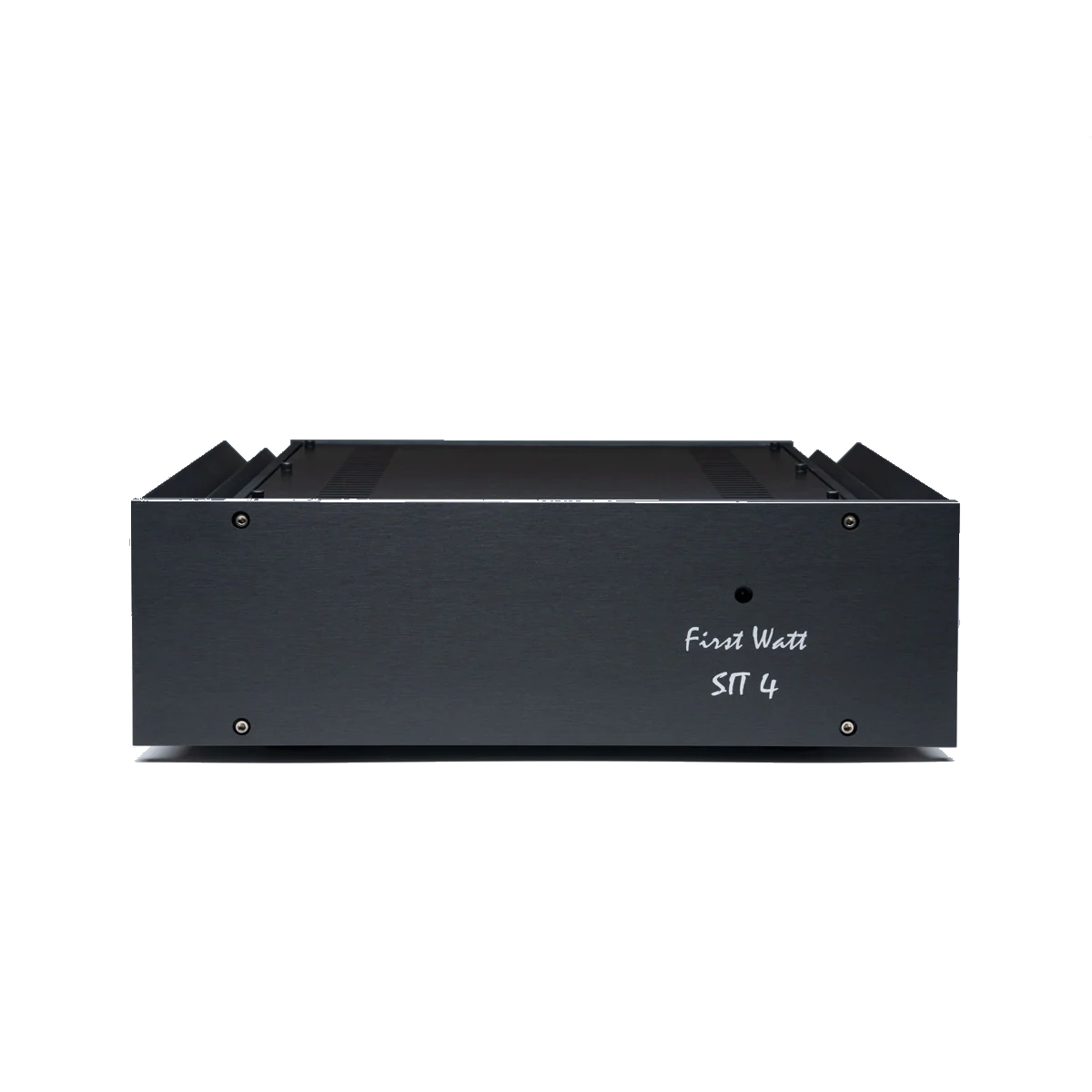
Pass Labs First Watt FW SIT4
$5,000.00
The SIT-4 is the most recent amplifier produced by First Watt, and is the fourth to use Static Induction Transistors (SIT) as the power amplifying device. In 2011 we introduced our first SIT amplifier using a custom Silicon Carbide (SiC) transistor part made by SemiSouth. The amplifier used a single power device, operating without feedback in single-ended Class A “Common-Source” mode to deliver 10 watts of power emulating the characteristic of a Triode, but operating at voltage and currents directly needed by loudspeakers, eliminating the output transformer. Do simple SIT amplifiers sound the same as single-ended Triodes (SETs)? Maybe not – it would be a matter of opinion. Without an output transformer with its significant limitations, the SIT has a bandwidth and distortion edge. I suppose if it glowed as well, it might be perfect 😉
Description
The SIT-4 is the most recent amplifier produced by First Watt, and is the fourth to use Static Induction Transistors (SIT) as the power amplifying device. In 2011 we introduced our first SIT amplifier using a custom Silicon Carbide (SiC) transistor part made by SemiSouth. The amplifier used a single power device, operating without feedback in single-ended Class A “Common-Source” mode to deliver 10 watts of power emulating the characteristic of a Triode, but operating at voltage and currents directly needed by loudspeakers, eliminating the output transformer.
The success of the monoblock SIT-1 led to the SIT-2, which offered similar performance at higher efficiency, and two channels in the same chassis. 2018 saw production of the SIT-3 which operated the SIT transistor in Common-Drain (follower) mode, again without feedback which was available until 2023.
Some years prior, SemiSouth suffered bankruptcy and we found ourselves unable to acquire more of this special part. However there was a company in Japan – Tokin, known for making industrial Silicon SIT parts suitable for audio use. Their production facility was destroyed the Fukushima earthquake, but we were able to acquire these parts from existing inventories of the Tokin devices over a period of several years. These large Tokin SITs enjoy that same Triode character, but at higher voltage, current and power ratings than our original SITs.
A special variety of Jfet invented in Japan in the 1950’s, in the 1970’s SITs enjoyed popularity in the “Vfet” power amplifiers from Sony and Yamaha that are still highly regarded in high end audio. Ultimately the difficulty and expense of SIT manufacture made them less competitive compared to later bipolar transistors, and it is only more recently that their superior qualities have been recognized for high end audio.
SIT devices have a unique characteristic which is of particular value for audio amplifiers. Quoting inventor Nishizawa’s patent abstract, “(The) drain-current to drain-voltage characteristic simulates the anode-current to anode-voltage characteristic of the Triode vacuum tube very closely.”
As with Triodes, the characteristic curves of the SIT allow operation on Class A “load lines” that can determine the relative values of second and third order harmonics and have little in the way of higher order distortion. It is a now a common observation that the most appealing sound tends to come from a dominant second order harmonic character followed by a lesser values of higher order harmonics.
SITs continued to be used in microwave, radar and other exotic applications, but after Sony and Yamaha ceased production, they largely disappeared from audio amplifiers. Recently there has been renewed interest in SITs, partly because two audio companies stepped up and spent the money required to fabricate new devices suitable for audio power amplifiers.
The first of these was Digital Do Main in Japan, which produced at least two audio amplifiers based on newer Tokin versions of original Yamaha parts. The other was First Watt, with the SemiSouth Silicon Carbide 50 watt device in the SIT-1, 2 and 3. The new SIT-4 uses the Tokin THF51s rated at 600 volts, 30 amps and 400 watts in a 10 watt/ch amplifier.
Measured at 120 V AC and an 8 ohm load:
Distortion @ 1 watt 0.6%
Input Impedance 100 Kohm
Gain 20 dB
Output Impedance 4 ohms
Output power 10 watts @ 2% THD, 8 ohms
Frequency response 4 Hz to 80 Khz (-3 dB)
Noise 75 uV unweighted, 20-20 KHz
Power consumption 200 watts
Fuse 3AG slow blow type –
2.5 Amp for 120VAC
1.25 Amp for 240 VAC
Weight 32 lbs
Dimensions 17” W x 15” D x 5” H
You must be logged in to post a review.
Reviews
There are no reviews yet.