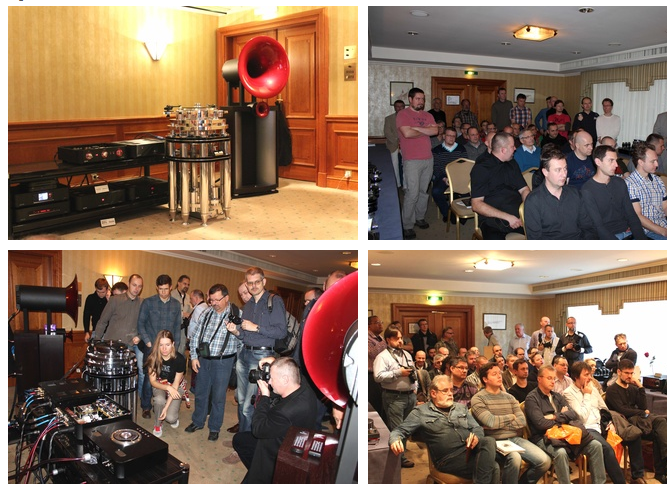
High End Show 2014- Warsaw/Poland

November 6-8, 2014

Ayon equipment in Demo there:

Crossfire Evolution – Monoblock

Spheris III – Linestage

Spheris – Phonostage

CD-T – CD-Transport

NW-T – Network-Transport

Sigma – D/A Converter
Development of current version of this preamplifier took 25 years – it is really hard to imagine – a quarter of a century! That also means 25 years of investing in a project – it took not only a lot of time but also effort and money. Spheris III playing music confirms in every millisecond that it's been a damn good investment worth every penny, sweat and minute spend on development. It is remarkable in every aspect. It offers its own vision of sound that is rather different then better than few other equally fantastic linestages.  This was a “no-brainer” for me. This device pushes all buttons inside my head that make listening to the music a pure pleasure and a challenge at the same time. This preamplifier works flawlessly with any power amplifier and any source. It is built of innovation and passion. And passion is a bonus we get with it, it is what makes it special and not just another product. This is priceless for every music lover.  The Spheris no. III repeats the idea Ayon used already in 2005 for version no. I – separate casings for power supply and the rest of the device. Starting with no. ‘II’ casing started to look similar to that of Polaris, i.e. with round corners and all panels made of aluminum. Also large chromed knobs are similar. These allow to select an active input, control volume and set balance between right and left channel. There is an additional element that makes it easy to differentiate Spheris from Polaris – all knobs have a round, red, backlit acrylic bands around them. The backlit can be switched off with a small switch placed on the back of the device. It is so discrete though that I never felt a need to do so. On a front panel there is another new element – a small alphanumeric display showing current volume.  This last element make you wonder – why there is exactly the same knob for volume control taken from version ‘II’ that sports a large dot that help you to recognize the position of this round knob. This dot was useful before but now the knob controls encoder and just turns round and round. So in fact this dot misleads user. There are two small red LEDs next to the knob that indicate that device is on (same as those red bands around knobs) and the other shows when „mute” function is active.  The back panel looks very nice. There are two rows of RCA sockets and XLR input and output – it is a fully balanced device. There are six inputs – one balanced and five unbalanced, and as many as four outputs – one balanced and two unbalanced (with adjustable signal level), and one tape out that might be also use to send signal to headphone amplifier. But to use it the device must be on. Sockets are arranged in a different way than in previous versions – before Gerhard used Audio Research's system, with right (red) channel on top, and left (white) below. Most manufacturers use opposite arrangement and this device also uses it.  All electronic circuits are mounted on few PCBs. The most important of them are the ones with four horizontally mounted Siemens C3m penthodes – the ones in my unit were made before II World War and come from a supply of German post. Each of them works in triode mode, a pair works in each channel – as channels are balanced they require two tubes for right and two tubes for left channel.  It is amazingly simple circuit, at least if we consider only a signal transfer. Signal goes from inputs to the PCB with relays. Then, with cables, it goes to the front of the device, to four (two per channel) transformers with multiple tappings. Signal level is changed via change of ratio between primary and secondary winding. It is the same solution as the one used in Music First Audio preamplifiers for example.  Transformers with classic core are made by Ayon in-house, and to switch windings they used an innovative system of relays instead of mechanical switch they used previously. And finally signal reaches tubes, and than the output via a single large Mundorf MCap Supreme Silver/Gold capacitor. All passive elements were carefully selected during listening sessions and all, obviously, are high class ones. There are Lundahl transformers in the input section – signal from RCA inputs is symmetrized and then processed in balanced form. The power supply sits in a separate casing but its small part is located in the main casing of the device. There is a large Lundahl choke and two huge polypropylene capacitors that are a part of power supply circuit for anode. There are no electrolytic capacitors in tubes' power supply circuit.  The main unit is connected with external power supply with a multi-core umbilical. Cable for Spheris III is more flexible and it sports much larger plug than the one for Polaris III (have a look at the picture in the gallery). Power supply sports two large (I mean high-power amplifier large) toroidal transformers, shielded with metal covers. The anode voltage is rectified in CV135 tubes, full-wave rectifier, with polypropylene capacitor following. As you can see both channels use the same power supply. It seems that the second transformer supplies a large PCB at the back of main unit's casing, that transforms voltage from power grid into pure sinusoid @ 60 Hz. You can see this value displayed on the front panel of the device. Only this “re-generated” voltage is sent to transformer that supplies power to the main unit. This whole circuit is called: AC~ ReGenerator.  This device has a classic Ayon's looks with extremely solid casing, engraved writings on it and anty-vibration feet. It still benefits from a good anti-vibration platform and even more advanced feet – I use Franc Audio Accessories Ceramic Disc Classic. The whole electronic circuit seems very simple from electric point of view but its execution is very complex. Power supply itself is as important as the circuit supplying it.  Spheris III comes equipped with a simple, small remote control that allows user to change volume and use a „mute” function.  Specifications (according to manufacturer)  Class of operation: class A/triode Tube complement: C3m Maximum output (@ 1 kHz ): 40 V rms S/N ratio: > 98 dB Input impedance: > 1 MΩ Output impedance: 30 Ω Frequency response/Line: 0,5 Hz – 500 kHz Harmonic distortion (@ 1 V) Line: < 0,01% AC~ ReGenerator: max. 300 W AC~ ReGenerator frequency: 60 Hz Dimensions Pre (WxDxH): 500 x 430 x 110 mm Dimensions ReGenerator (WxDxH): 500 x 430 x 110 mm Weight (pre & power supply): 43 kg

Leave a Comment

You must be logged in to post a comment.